Klikkaa sinistä "Siirry kohteeseen" -painiketta ostaaksesi kohteen tai tehdäksesi tarjouksen. Kokonaishinta näytetään ennen tarjouksen vahvistamista.
- Tärkeää:
Voittavaan tarjoukseen lisätään 9 % ostajansuoja + €3K sekä toimituskulut.
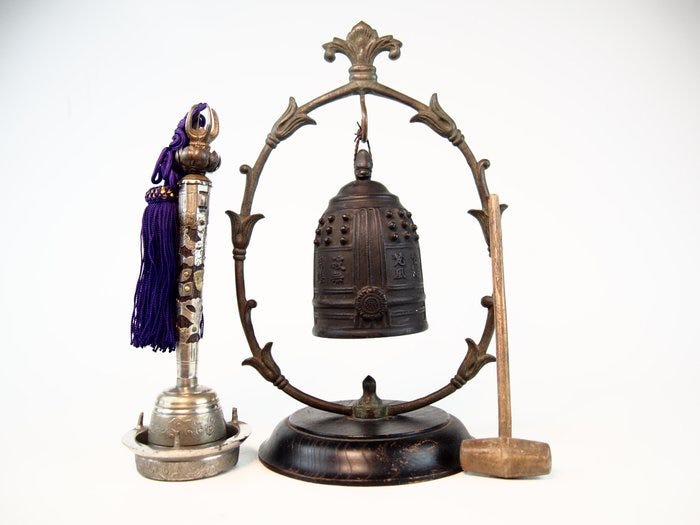
This is a distinctive set of Japanese Buddhist ritual objects consisting of an elaborately decorated four-pronged Vajra Bell (四鈷鈴) with a purple ceremonial tassel, together with a separate small temple-bell-shaped ritual bell bearing a 16-character Buddhist inscription, accompanied by its decorative stand, tray and striker.
The combination of the two different bell forms, their contrasting decoration, and the religious inscription gives this group considerable character and collector interest.
Four-Pronged Vajra Bell 四鈷鈴
The principal bell is an elaborately decorated metal ritual bell with a tall ornamental handle.
At the top is a distinctive four-pronged vajra-shaped finial, giving the bell its characteristic four-pronged form. The handle is richly decorated with layered metalwork, scrolling ornament and lotus-inspired elements, while the bell body is embellished with several decorative bands and scrolling or cloud-like motifs.
A purple braided ceremonial tassel remains attached to the handle. The tassel is complemented by decorative metal fittings, including a circular fitting with a tomoe-style motif.
The bell contains an internal clapper and remains a functional ritual bell.
Inscribed Temple Bell
The second bell is a smaller, more traditionally shaped Japanese temple-bell form. Although modest in overall size, it has particularly substantial and well-defined nyū (乳) — the raised bosses arranged around the body of traditional Japanese bells.
These prominent raised bosses give the bell a surprisingly powerful presence in relation to its relatively compact size and are an especially attractive feature for collectors interested in traditional Japanese bell forms.
The bell is also noteworthy for the inscription carved across its four sides.
The inscription consists of 16 Chinese characters, four characters on each of four sides.
The characters appear to read approximately:
罷有漏夢
遂令法界
皆嚮梵風
破無明闇
The third group contains a character whose exact reading is difficult to establish from the surviving inscription. Its form appears close to the old character 嚮, which is structurally composed of 鄉 and 向 and can mean “to turn toward,” “to incline toward,” or, in certain usages, relate to sound or resonance. The reading therefore remains somewhat tentative.
The inscription is particularly interesting because several of its expressions have clear Buddhist significance.
有漏 (uro) is a Buddhist term referring to phenomena associated with defilement, attachment and the cycle of delusion. The following 夢 (dream) can be understood in the Buddhist sense of the dream-like or illusory nature of worldly existence.
法界 (hokkai) is one of the major concepts of Mahayana Buddhism, referring to the Dharma realm or the total sphere of phenomena and ultimate reality.
梵風 (bonpū) is a Buddhist expression associated with the pure or sacred “wind” of Buddhist teaching. Historical Buddhist texts and temple writings use the expression in connection with the power of Buddhist teachings to dispel impurity and bring spiritual benefit. An old collection of Japanese bell inscriptions also records the expression 「梵風惠物」, showing that the term was used in the context of bell inscriptions and Buddhist thought.
The final four characters, 破無明闇, are especially clear in their Buddhist meaning:
“to break the darkness of ignorance.”
The expression 無明闇 refers to the darkness of avidyā, the fundamental ignorance or delusion that prevents beings from seeing Buddhist truth. The expression 破無明闇 is found in Buddhist literature and describes the breaking of this darkness through wisdom and spiritual awakening.
Taken as a whole, the inscription can therefore be understood as expressing the Buddhist idea that the sacred sound or inf