

ToriDiili
Toimitus alkaen 2,99 € + ToriDiili-palvelumaksu 2 €
ToriDiili on Torin uusi maksu- ja kuljetuspalvelu. Toimituksen jälkeen sinulla on 24 tuntia aikaa tarkastaa tuote ennen kuin rahat siirretään myyjälle.
Kunto: Kuin uusi
PHILOSOPHY
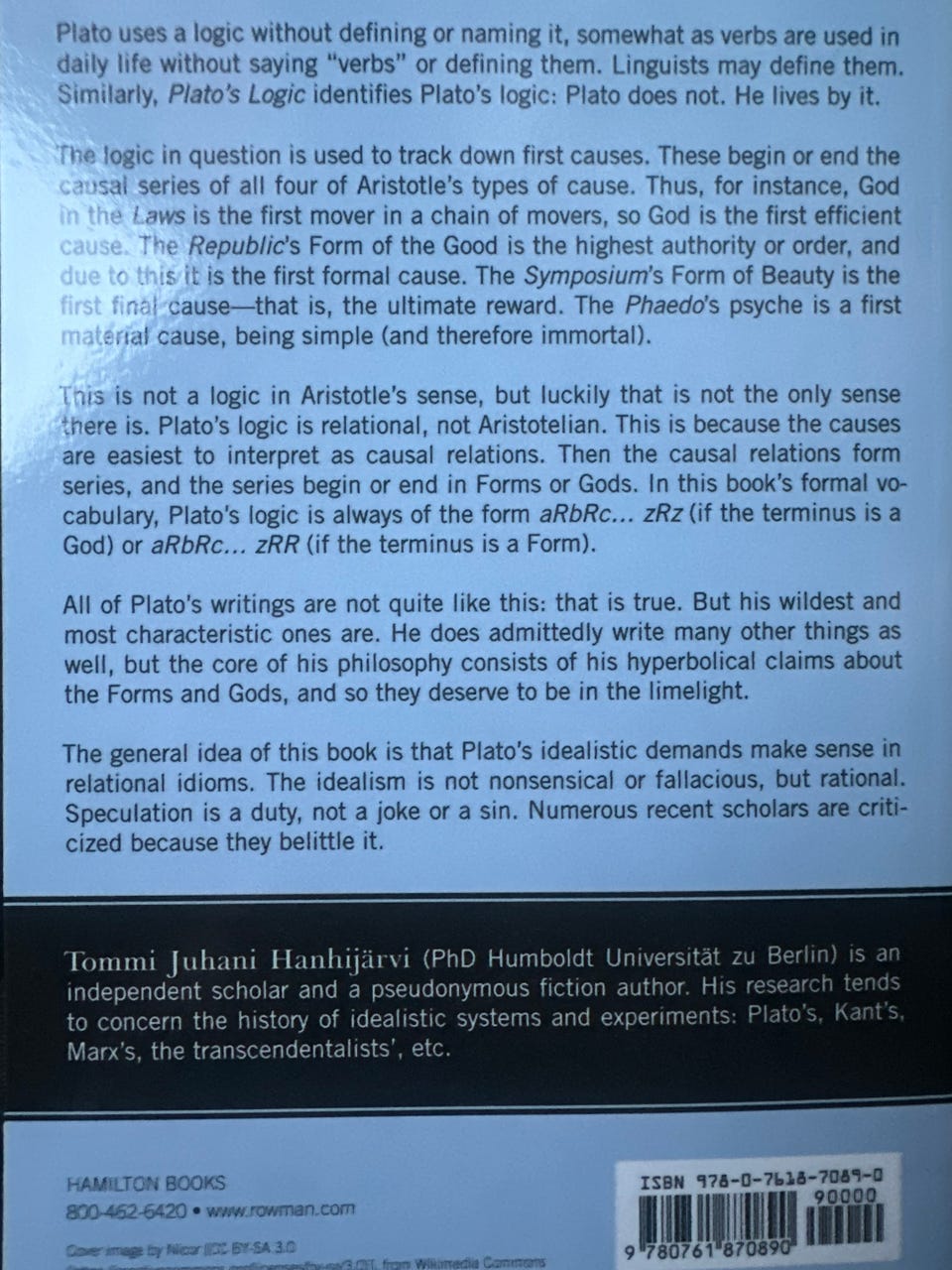
Plato uses a logic without defining or naming it, somewhat as verbs are used in daily life without saying “verbs” or defining them. Linguists may define them. Similarly, Plato’s Logic identifies Plato’s logic: Plato does not. He lives by it.
The logic in question is used to track down first causes. These begin or end the causal series of all four of Aristotle’s types of cause. Thus, for instance, God in the Laws is the first mover in a chain of movers, so God is the first efficient cause. The Republic’s Form of the Good is the highest authority or order, and due to this it is the first formal cause. The Symposium’s Form of Beauty is the first final cause—that is, the ultimate reward. The Phaedo’s psyche is a first material cause, being simple (and therefore immortal).
This is not a logic in Aristotle’s sense, but luckily that is not the only sense there is. Plato’s logic is relational, not Aristotelian. This is because the causes are easiest to interpret as causal relations. Then the causal relations form series, and the series begin or end in Forms or Gods. In this book’s formal vocabulary, Plato’s logic is always of the form aRbRc… zRz (if the terminus is a God) or aRbRc… zRR (if the terminus is a Form).
All of Plato’s writings are not quite like this: that is true. But his wildest and most characteristic ones are. He does admittedly write many other things as well, but the core of his philosophy consists of his hyperbolical claims about the Forms and Gods, and so they deserve to be in the limelight.
The general idea of this book is that Plato’s idealistic demands make sense in relational idioms. The idealism is not nonsensical or fallacious, but rational. Speculation is a duty, not a joke or a sin. Numerous recent scholars are criticized because they belittle it.
Tommi Juhani Hanhijärvi (PhD Humboldt Universität zu Berlin) is an independent scholar and a pseudonymous fiction author. His research tends to concern the history of idealistic systems and experiments: Plato’s, Kant’s, Marx’s, the transcendentalists’, etc.
HAMILTON BOOKS
800-462-6420
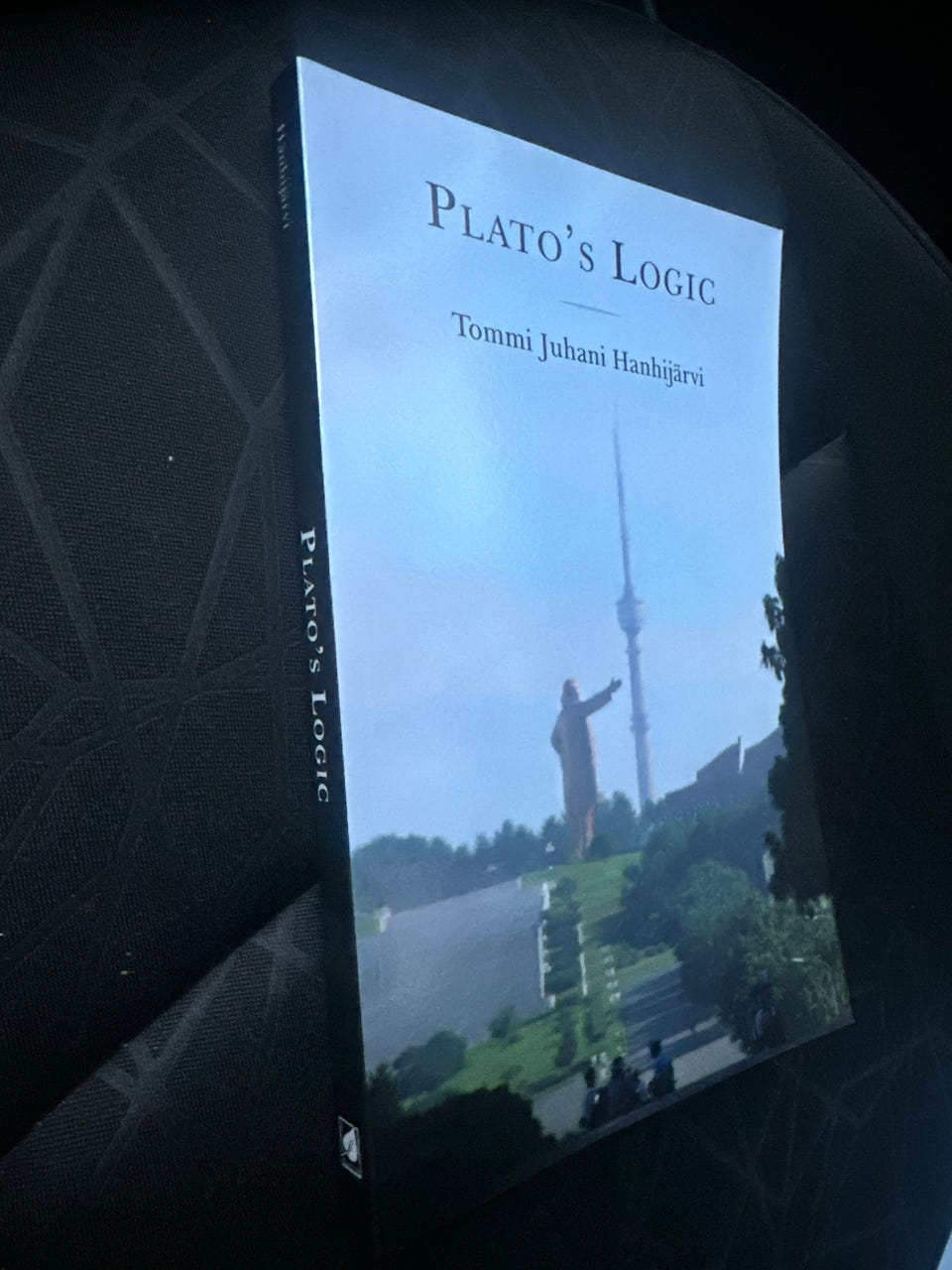
Cover image by Nicer (CC BY-SA 3.0)
ISBN 978-0-7618-7089-0
90000

Kirjaudu sisään, jos haluat nähdä profiilin ja lähettää viestejä.
Kirjaudu sisäänViimeksi muokattu: 2.1.2026 klo 13.16 ・ Ilmoituksen tunnus: 35139773