Klikkaa sinistä "Siirry kohteeseen" -painiketta ostaaksesi kohteen tai tehdäksesi tarjouksen. Kokonaishinta näytetään ennen tarjouksen vahvistamista.
- Tärkeää:
Voittavaan tarjoukseen lisätään 9 % ostajansuoja + €3K sekä toimituskulut.
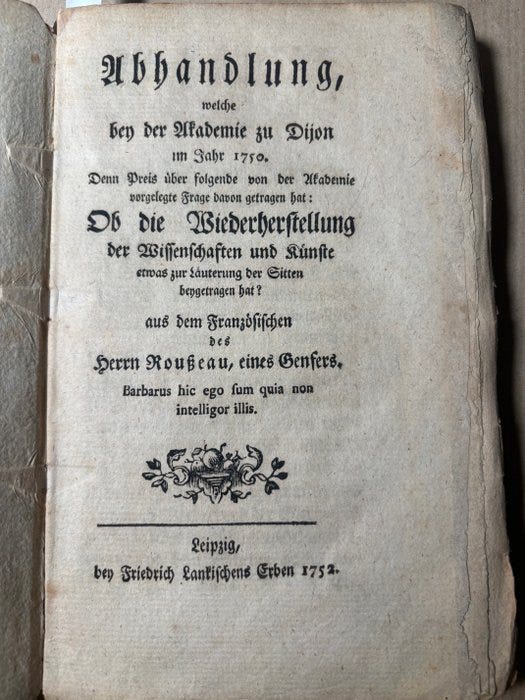
"Abhandlung, welche bey der Akademie zu Dijon im Jahr 1750. Denn Preis über folgende von der Akademie vorgelegte Frage davon getragen hat: Ob die Wiederherstellung der Wissenschaften und Künste etwas zur Läuterung der Sitten beygetragen hat?" 2 volumes complete. Bound together with “Rede des Herrn von Voltaire, welche er bey seiner Aufnahme in die französische Akademie den 9. May 1746. gehalten; Nebst der Antwort des Herrn Abts Oliver” and “Sendschreiben an den Herrn von Voltaire über den Charakter des Doctor Martin Luther und Seine Reformation” - Jean-Jacques Rousseau / Johann Daniel Titius (Tietz) (translation) / Voltaire / [Justus Möser]
Leipzig: Bey Friedrich Lankisches Erben, 1752 / No location and publisher mentioned, 1747 / Göttingen: Daniel Friedrich Kübler, 1752. Part I (Rosseau, 2 volumes): 61, [1], 134, [2] pages; Part II (Voltaire): 47, [1] pages; Part 3 (Möser): 27 pages. 19.5cm x 12.5cm. Softcover with stone grey plain wrappers. A Spectacular 18th-Century Intellectual Dialogue: Three Foundational Enlightenment Texts Bound in One Volume, Documenting the Fierce Trans-European Debate on Culture, Virtue, and the Reformation (1747–1752).
1. [ROUSSEAU, Jean-Jacques] — True First German Edition of Rousseau's Breakthrough First Discourse. The exceptionally rare first German translation of Rousseau’s foundational debut work, "Discours sur les sciences et les arts". Translated anonymously by the young polymath Johann Daniel Titius (later famed for the Titius-Bode Law), this text served as the primary vehicle that introduced Rousseau's radical, anti-establishment culture critique to the German-speaking world, profoundly impacting Immanuel Kant and the Sturm und Drang movement.
2. VOLTAIRE [Arouet, François-Marie] — Early German Printing of Voltaire’s Academy Triumph. The scarce first-generation German translation of Voltaire's highly celebrated reception speech upon finally gaining entry to the Académie Française. A masterclass in linguistic pride and literary history, published alongside the official academic counterresponse by Abbé Pierre-Joseph Alary (here translated as Abt Oliver). This text represents the absolute apex of the elite French cultural establishment that Rousseau sought to dismantle.
3. [MÖSER, Justus] — First German Edition of Möser's First Major Work Defending Luther.
The rare first German edition of Justus Möser's brilliant, patriotic defense of German spiritual history, translated from his original 1750 French manuscript by G.W. Bokelmann. Signed with Möser's initials "J.M." on the final text page. Written as a direct open letter to Voltaire, Möser fiercely rebuts the French philosopher's cynical mockery of the German Reformation, arguing instead that Martin Luther's spiritual rebellion laid the necessary groundwork for true European intellectual liberty.
this remarkable Sammelband (composite volume) is not merely a collection of random contemporary tracts; it represents a perfectly curated, three-way ideological boxing match physicalized in a single artifact. Assembled by an astute 18th-century intellectual observer, the volume pits the three titans of the era directly against one another: Voltaire enters first, celebrating the supreme elegance and triumph of high French academic culture. Rousseau follows immediately after, radically subverting the entire Enlightenment zeitgeist by arguing that such high arts and sciences are actually instruments of moral corruption and human subjugation. Finally, Justus Möser steps into the ring, directly confronting Voltaire's Eurocentric elitism by defending German history and the Protestant Reformation as the true, rugged cradle of modern liberty. A spectacular, highly cohesive artifact documenting the precise moment French radic