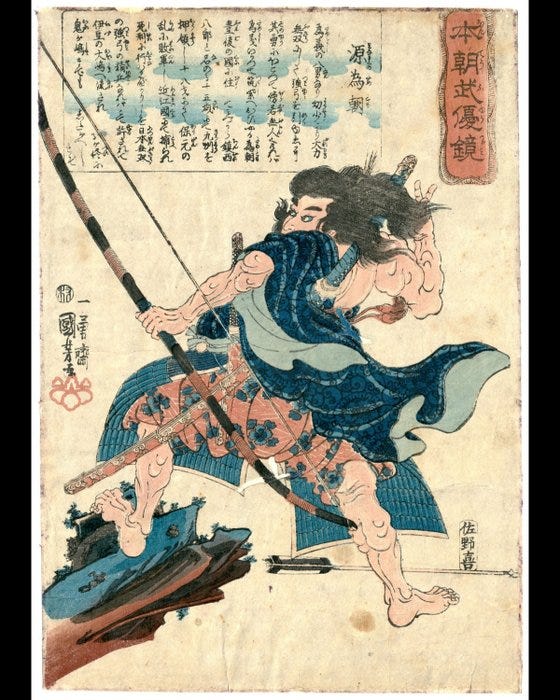
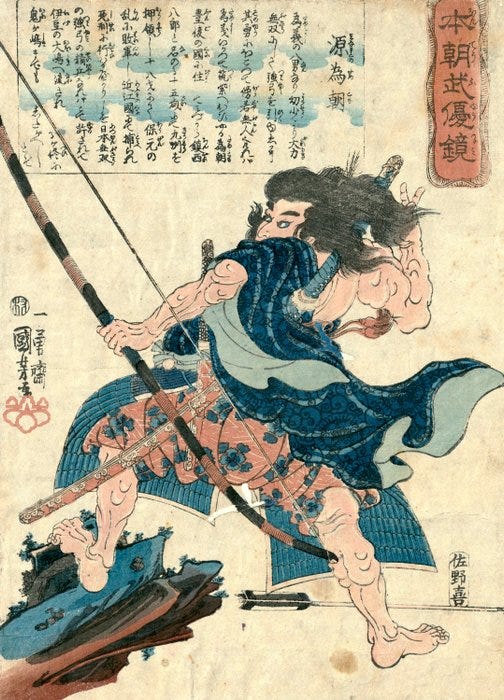
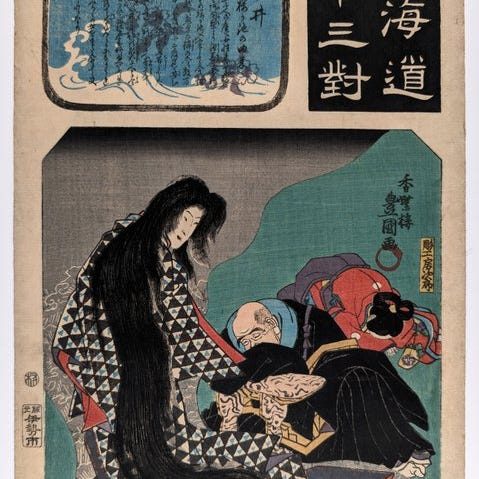
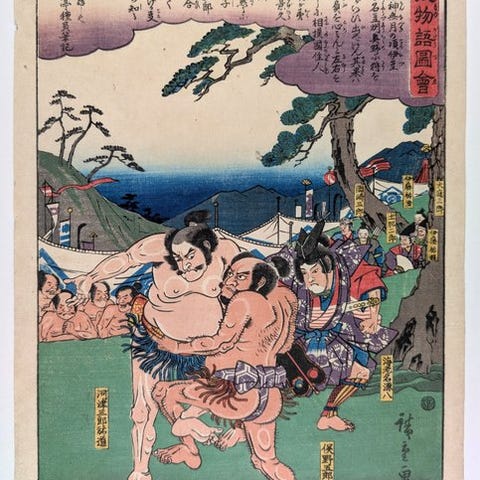
Utagawa Kuniyoshin signeeraama alkuperäinen japanilainen monivärinen puupiirros, jossa Minamoto no Tametomo *Honchō Buyū Kagami* -sarjasta; vuodelta 1843, koko 36 × 25,3 cm ja kunnoltaan tyydyttävä.
Kiinnostuitko kohteesta? Siirry Catawikiin ostamaan tai tekemään tarjous painamalla punaista ”Siirry myyjän sivustolle” -painiketta. Näet kokonaishinnan ennen tarjouksen vahvistamista.
- Tärkeää:
Voittavaan tarjoukseen lisätään 9 % ostajansuoja + €3 sekä toimituskulut.
Original Japanese woodblock print,
Artist: Utagawa Kuniyoshi (1797-1861) 歌川国芳
Title : Honchō Buyū Kagami – Minamoto no Tametomo (本朝武優鏡 源為朝)
Signature: Ichiyūsai Kuniyoshi ga (一勇斎國芳画)
Publisher: Sanoya Kihei (佐野喜)
Date: ca.1843 - 1847 Edo Period
Size: H36 × W25.3cm
Material: Washi (Traditional Japanese paper)
Technique: Multi-colour woodblock printing(Nishiki-e)
Condition: There are some stains, age-related toning, trimming, and repaired holes. The colors remain beautiful considering the age of the print. Please refer to the images for further details.
The British Museum:
https://cultural.jp/en/item/arc_nishikie-BM_2008_3037_08005
This original Japanese woodblock print (ōban nishiki-e) is from *Honchō Buyū Kagami* (*Mirror of Japanese Military Heroes*), a series by the renowned Edo-period ukiyo-e artist Utagawa Kuniyoshi (1797–1861), depicting warriors from Japanese history and legend. This particular print portrays Minamoto no Tametomo (1139–1170), a warrior of the late Heian period.
The historical Tametomo was born as the eighth son of Minamoto no Tameyoshi.
He is said to have been naturally gifted with an extraordinary physique, standing nearly two meters tall. His left arm was reportedly unusually longer than his right, giving him a physical advantage ideally suited to drawing a powerful bow.
Because of his extremely violent behavior from childhood, he was disowned by his father and sent away to Kyushu at the age of thirteen. However, within just three years, he brought the entire island of Kyushu under his military control.
Later, during the Hōgen Rebellion of 1156, he fought on the side of the retired Emperor Sutoku, terrifying the forces of his elder brother, Minamoto no Yoshitomo, and Taira no Kiyomori with his exceptionally powerful bow.
After his defeat, Tametomo was captured in Ōmi Province (present-day Shiga Prefecture). His life was spared in recognition of his extraordinary military prowess. However, to prevent him from ever drawing a bow again, the tendons in his elbows were severed, and he was exiled to Izu Ōshima.
Even there, he refused to remain quiet and effectively brought the surrounding islands under his control. Eventually, he was cornered by a punitive force sent by the imperial court. Realizing that his end had come, he proudly took his own life through seppuku, in keeping with his honor as a samurai. This is regarded as one of the earliest reliably recorded instances of seppuku in Japanese history.
The inscription at the top of the print recounts Tametomo's life, including his conquest of Kyushu at the age of fifteen, his defeat in the Hōgen Rebellion, his exile to Izu Ōshima, and the legend that he eventually brought even Onigashima (the Island of Demons) under his control.
Tametomo dominates the composition, his piercing gaze and extraordinary physique creating a powerful impression. Through Kuniyoshi's characteristic dynamic composition, the artist conveys the legendary warrior's almost superhuman strength, suggesting a man whose power could rival even that of demons.
*Inscription:
ー He was the eighth son of Minamoto no Tameyoshi.
From childhood, he possessed unrivaled physical strength and could draw an exceptionally powerful bow. Proud of his bravery, he behaved arrogantly and without regard for others, which angered his father, Tameyoshi, who sent him away to Tsukushi (Kyushu).
Tametomo settled in Bungo Province and called himself Chinzei Hachirō.
At the age of fifteen, he seized control of Kyushu. At eighteen, he was defeated in the Hōgen Rebellion and captured in Ōmi Province.
Although he was to be executed, his life was spared because he was an unrivaled master of the powerful bow, without equal in all Japan. Instead, he was exiled to Izu Ōshima.
It is said that he eventually went so far as to bring even the Island of Demons (Onigashima 鬼ヶ島) under his control. ー
*All prints are carefully packaged and shipped safely and promptly via DHL or Japan Post EMS, with tracking provided.
【Important Notes】
• For international buyers
Any import duties, taxes, customs clearance fees, or other charges not included in the item price or shipping cost are the responsibility of the buyer.
Please note that VAT paid through Catawiki does not cover customs duties or carrier handling fees that may be charged in the destination country.
• Shipping
All items are carefully packaged and shipped with tracking via DHL, FedEx, or Japan Post EMS.
Estimated delivery times:
Japan Post EMS: approximately 2–3 weeks
DHL: approximately 5–10 days
*Delivery times may vary depending on the destination and customs clearance.
*To help ensure smooth delivery, please respond promptly to any messages or requests from the shipping carrier or local customs authorities.
• Damage or issues
In the unlikely event that an item arrives damaged or there is any other issue, please contact both me and Catawiki Support promptly.
• Photos and color
I make every effort to accurately represent the item’s colors and textures in the photographs. However, slight variations may occur due to monitor settings and photographic conditions.
Please review the description and all images carefully before bidding.
Thank you for your interest!
Tietoa Catawikista
Catawiki on vuonna 2008 perustettu alankomaalainen verkkohuutokauppa-alusta. Olemme tunnettuja siitä, että olemme erikoistuneet harvinaisten ja poikkeuksellisten esineiden huutokauppoihin. Catawikilla asiantuntijatiimimme arvioi ja tarkistaa kohteet ennen niiden julkaisemista huutokauppaan varmistaakseen niiden aitouden ja laadun.